Adult Culex and Aedes mosquitoes require shade and microclimates with elevated humidity to survive Oklahoma County summer heat, resting primarily beneath dense broadleaf vegetation during peak daylight hours.…
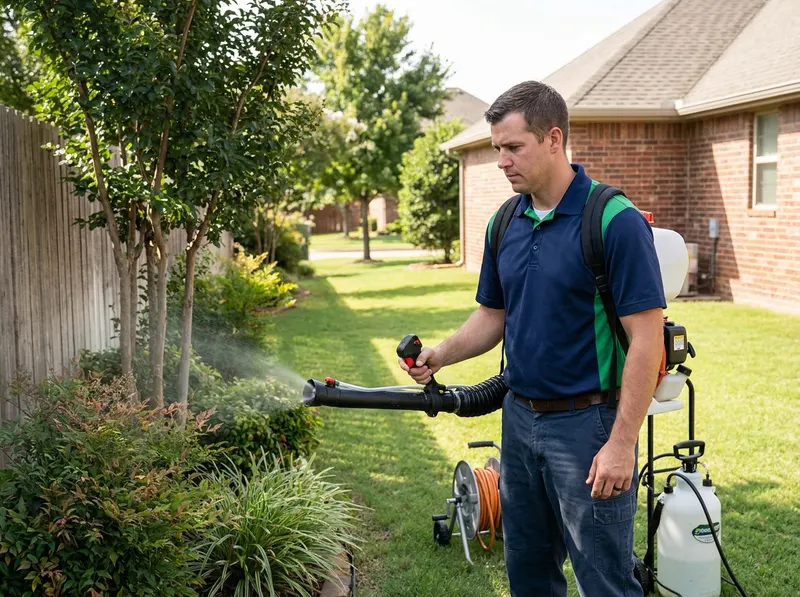
Adult Culex and Aedes mosquitoes require shade and microclimates with elevated humidity to survive Oklahoma County summer heat, resting primarily beneath dense broadleaf vegetation during peak daylight hours. Properties near the water-shedding topography of Lake Hefner or heavily landscaped historic parcels in Heritage Hills and Mesta Park provide stable microhabitats that support rapid reproduction cycles. Effective management relies on a mechanical barrier application directed specifically at the undersides of leaves up to 10 feet high, rather than broadcast open-air spraying. Micro-encapsulated synthetic pyrethroids bind to plant surfaces to eliminate adult vectors on contact without damaging ornamental plantings. Open-air thermal fogs deliver an immediate spatial knockdown for an outdoor event but carry zero residual duration once the cloud dissipates; directed surface applications remain active for 21 to 30 days.
Controlling active vectors requires treating aquatic emergence sites alongside adult daytime shelters. Oklahoma City municipal drainage patterns frequently retain shallow runoff along street gutters, corrugated downspout extensions, and low-lying perimeter easements across Crown Heights, Capitol Hill, and The Paseo Arts District. Applying biological larvicides containing Bacillus thuringiensis israelensis (BTI) to birdbaths, French drains, and unmanaged retention catchments destroys mosquito larvae within 24 hours while remaining non-toxic to birds, pollinators, and domestic pets. Trade-offs between program structures depend on surrounding environment: a single corrective treatment lowers biting pressure for temporary relief, whereas recurring applications spaced at 28-day intervals throughout the April-to-October active vector window prevent multi-generational re-infestation from bordering unmanaged parcels.
Dense canopy coverage on historic lots in Midtown and the Plaza District demands higher material volumes than open-turf parcels along the Nichols Hills Suburban Edge or newer subdivisions in Quail Springs. Treatment failure typically stems from unaddressed elevated resting sites or unemptied reservoirs such as clogged roof gutters or perimeter tarp depressions. Structural barriers establish an exterior exclusion envelope, minimizing vectors that enter living spaces through unscreened windows, crawl space foundations, or active exterior doorways.
Every job gets a firm, written price after a free on-site visit.
Tell us about your mosquito reduction treatment job in Oklahoma City and we'll send a clear, written quote, usually the same day.
 Zorevia Insect Specialists